How Singapore Employers Use AI to Screen CVs in 2026 (And What Gets You Through)
· Keith Kwai

Your CV is now read twice: once by software that decides whether a person sees it, and once by the person. Most job seekers write for the second reader and get stopped by the first.
That has been partly true since applicant tracking systems arrived. What has changed in 2026 is the scale and the type of tool. Screening has moved from simple keyword filters to AI that ranks, summarises and scores candidates. This guide explains what Singapore employers are actually using, where a human still makes the decision, and what to change in your CV so it gets through both readers. It builds on our earlier guide to what recruiters see when they open your CV.
What the latest Singapore data says
In October 2026, the Singapore National Employers Federation released a survey of 1,000 employers on AI in HR. The main findings:
- Employers reported nearly 3,000 different uses of AI across HR functions.
- In 85% of those uses, a person confirmed the final decision. Most of the remaining uses were high-volume tasks, with resume screening and skills tests among the most common.
- Adoption was higher at larger firms with more than 200 staff, at 81%, than at SMEs, at 65%.
Read that second point carefully. When AI decides on its own, it tends to be at the top of the funnel, which is exactly where your CV sits. A person may make the final hiring call, but software often decides which CVs that person sees.
A day earlier, Minister of State for Manpower Foo Cexiang set out three principles for employers using AI in hiring: be open when AI shapes a decision about someone, keep real human contact at key moments such as interviews, and take responsibility for people decisions instead of pointing to the algorithm. These are principles, not law, but they signal where expectations are heading.
What AI screening tools actually do
The tools vary, but most of what a Singapore jobseeker will run into falls into five categories.
1. Parsing
The system reads your CV file and pulls out structured data: name, contact details, job titles, employers, dates, education and skills. If it cannot read your file properly, everything after this step suffers. Two-column layouts, text in images, headers and footers, tables and unusual fonts are the usual culprits.
2. Matching and ranking
The system compares your parsed profile with the job description and gives you a score or a rank. Older tools counted exact keywords. Newer AI tools look at meaning as well, so they may recognise that stakeholder management and managing senior stakeholders are related. But they still lean heavily on the language in the job ad, and they still reward clear, explicit evidence over implied skill.
3. Knockout questions
Questions on the application form such as Do you have the right to work in Singapore? or How many years of experience do you have in X? These are often hard filters. A wrong or careless answer removes you before anything else is read.
4. Summaries for the recruiter
Some systems generate a short summary of each candidate for the recruiter to scan. That summary is written from your CV. If your CV is vague, the summary will be vague, and a recruiter reviewing 200 summaries will move on.
5. Skills tests and assessments
Online tests, situational judgement questions or recorded video answers, sometimes scored partly by software. The SNEF survey named skills tests as one of the high-volume tasks where AI is used.
Where a person still decides
Most shortlisting decisions, interviews and final offers still involve people. The SNEF data supports that, and so does our experience of working with hiring managers. In practice, the pattern we see looks like this:
- Large employers and MNCs are more likely to use AI ranking on high-volume roles, and recruiters often start from the top of the ranked list.
- SMEs are more likely to use a basic applicant tracking system or a job portal’s built-in filters, and to have the hiring manager read CVs directly.
- Senior and niche roles rely more on referrals, search firms and direct approaches, where a person reads your CV first.
That means there is no single strategy for every application. But a CV that works for software and a CV that works for a person turn out to be almost the same document.
How to write a CV that gets through both readers
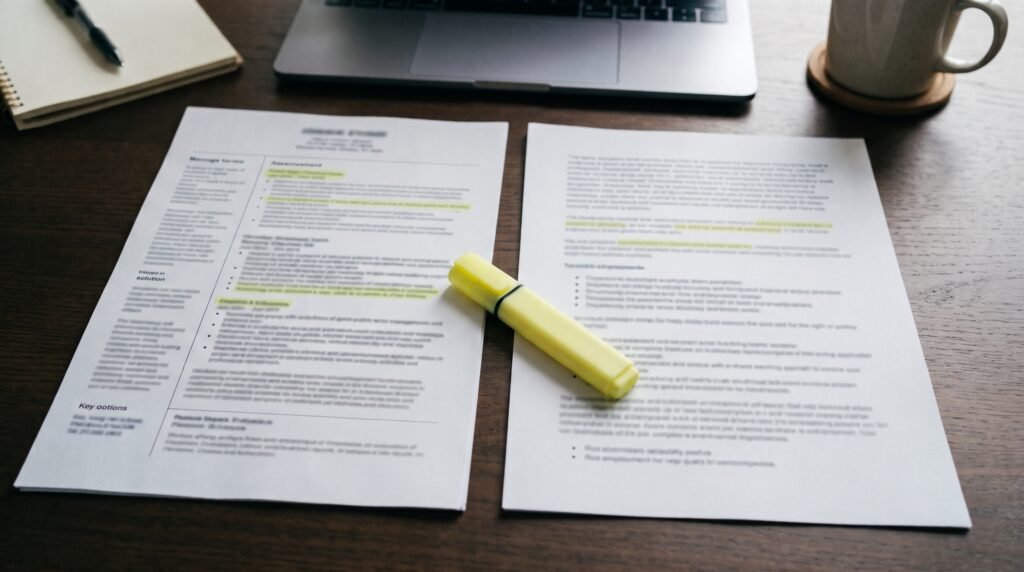
Use a format machines can read
- A single-column layout with standard section headings: Professional Summary, Experience, Education, Skills.
- A Word or text-based PDF file. Not a scanned image, and not a design exported as an image.
- Contact details in the body of the document, not in the header or footer.
- Standard fonts and simple bullet points. No text boxes, icons, rating bars or skill charts.
Mirror the job ad’s language, honestly
Read the job description and list the skills, tools and responsibilities it repeats. Where you genuinely have them, use the same words in your CV. If the ad says financial planning and analysis and your CV says budgeting, the tool may still connect them, but you are relying on luck. If the ad names a specific system and you have used it, name it.
Our free ATS score checker compares your CV against a job description and shows you the gaps. For a deeper explanation of keyword selection, see our guide to ATS keywords for your resume.
Make your job titles clear
Internal titles like Associate Director, Growth Excellence mean little outside your old company. You can add a plain-language version in brackets: Associate Director, Growth Excellence (Regional Marketing Lead). This helps both the software and the human recognise what you did.
Put evidence in every bullet
AI summaries and human readers both reward specifics. Compare these two bullets:
Responsible for managing vendor relationships across the region.
Renegotiated contracts with 14 regional logistics vendors, cutting freight cost by 11% in the first year.
The second one gives the tool more to match and gives the recruiter a reason to call.
Answer knockout questions carefully
Read each question twice. If the form asks for years of experience in a specific skill, count honestly and include relevant experience from earlier roles. If a question is ambiguous, answer in the way that is true and keeps you in the pool, then explain in the interview.
Keep your CV and LinkedIn consistent
Some tools and many recruiters check your LinkedIn profile against your CV. Different titles, dates or employers between the two look careless at best. Our LinkedIn profile guide covers how to align them.
Tricks that do not work, and can hurt you
- Hidden keywords in white text. Modern parsers read them, recruiters see them in the parsed view, and it looks like what it is.
- Pasting the whole job description into your CV. Matching tools may score it, but the first human who opens it will not.
- Keyword stuffing in a skills section. A list of 60 skills with no evidence in your experience section adds little and makes the CV harder to read.
- Writing the whole CV with a chatbot. Recruiters are getting good at spotting generic AI language, and AI-written CVs tend to sound the same as each other. We cover this in our guide to writing your resume with ChatGPT.
Your rights as a candidate
Singapore does not yet have a law that specifically regulates AI in hiring. But the rules that already apply to hiring apply whether a person or a tool makes the decision.
- Fair employment. The Tripartite Guidelines on Fair Employment Practices require employers to select candidates on merit. The Workplace Fairness Act, expected to take effect by the end of 2027, will make discrimination on grounds such as age, nationality, sex, race and disability unlawful in hiring decisions. An employer cannot avoid that responsibility by pointing to a tool.
- Personal data. The Personal Data Protection Act governs how employers collect and use your data, including your CV.
- Asking questions. It is reasonable to ask a recruiter whether AI is used in screening and whether a person reviews applications. With the MOS’s transparency principle on record, more employers will expect the question.
A quick checklist before you hit submit
- Single-column layout, standard headings, contact details in the body.
- File saved as Word or text-based PDF, and opens cleanly on a phone.
- Five to eight key terms from the job ad reflected honestly in your CV.
- Clear job titles, with plain-language versions where needed.
- Every bullet has an outcome, a number or a specific tool.
- Knockout questions answered carefully and truthfully.
- CV and LinkedIn match on titles, employers and dates.
A worked example: tailoring one CV for one job ad
Here is how this looks in practice. Say you are a logistics manager applying for a Regional Supply Chain Planner role at an MNC. The job ad repeats four things: demand planning, S&OP, SAP and stakeholder management across Asia-Pacific markets.
Your current CV says you managed warehouse operations, coordinated with sales teams and used the company ERP. Everything there may be true, but a screening tool sees weak overlap, and so does a recruiter skimming the AI summary.
The tailored version does four things, all honestly:
- Names the system. Company ERP becomes SAP S/4HANA (MM and SD modules), because that is what you used.
- Uses the ad’s term for the process. Monthly planning meetings with sales and finance becomes monthly S&OP cycle with sales and finance across four markets.
- Adds the evidence. Improved forecast accuracy from 68% to 81% over 12 months, reducing stock-outs at key accounts.
- Adjusts the summary. The first line now reads as a supply chain planner with regional S&OP experience, not as a warehouse manager.
Nothing in the new version is invented. It describes the same work in the language the employer uses, with proof attached. That is the whole skill, and it takes about 20 minutes per application type once your base CV is solid.
Frequently asked questions
Do Singapore companies use AI to reject CVs?
Many do use AI in screening. The October 2026 SNEF survey found that in 85% of AI uses in HR, a person confirmed the final decision, and resume screening was one of the main high-volume tasks where AI acted with less human review.
Is a PDF or Word CV better for AI screening?
Either works if it is text-based with simple formatting. Avoid PDFs exported from design tools, scanned documents and anything with text inside images.
Can I find out if AI rejected my application?
Usually not directly. You can ask the recruiter whether AI is used in screening and whether a person reviews applications. Expectations of transparency are rising, but there is no legal requirement to tell you yet.
Does using the same keywords as the job ad matter?
Yes. Newer tools understand related phrases better than older ones, but clear, matching language still improves your ranking and makes the CV easier for the recruiter to scan.
Should I make different CVs for different jobs?
You should tailor the summary, the order of your bullets and the key terms for each type of role. You do not need a completely different CV for every application.
Find out what the software sees
Run your CV through our free ATS score checker first. If you want a person to look at it too, our free CV review shows you how a recruiter reads it, and our ATS-optimised resume service rebuilds it for both readers.
Sources
- CNA, SNEF survey on AI in HR and recruitment (30 Oct 2026)
- Ministry of Manpower, Speech by MOS Foo Cexiang at the Best Workplaces Singapore Awards (29 Oct 2026)
- Singapore Law Watch, Parliament passes second Workplace Fairness Bill (5 Nov 2025)
- TAFEP, Tripartite Guidelines on Fair Employment Practices